What to Eat in Perimenopause: A Canadian NTP's Guide to Eating for Hormone Support After 40
Mar 27, 2026By Michelle Pfile | Hormone Health Educator & Advocate for Endocrine-Safe Wellness in Canada
If you've typed "what to eat in perimenopause" into Google recently — you're not alone.
It's one of the most searched questions by Canadian women over 40 right now. And honestly? The answers out there are overwhelming, conflicting, and often completely disconnected from what's actually happening in your body during this stage of life.
I'm Michelle Pfile, a Nutritional Therapy Practitioner based in Ontario, Canada, and the Founding Canadian Advocate for a hormone health brand I believe in deeply. I've spent years working with women in midlife and studying what actually moves the needle when it comes to hormones, gut health, and nutrition after 40.
And what I've found, both in my own body and in the women I work with, is that simplicity wins. Every single time.
That's why I created something I call The Glow Plate. It's not a diet. It's not a protocol. It's not another complicated plan with rules you'll abandon by week three. It's a single question you ask yourself at every single meal.
And it has changed everything for me, my energy, my digestion, my mood, my hormones, and the way I feel in my body every single day.
Let me walk you through it.
Why Most Perimenopause Nutrition Advice Gets It Wrong
WHAT IS THE GLOW PLATE?
The Glow Plate is built around one question: Do I have protein and plants on this plate?
That's it. That's the whole framework. No tracking. No macros. No colour coded meal plan. No guilt. No perfection required. Just two things built intentionally into every single meal, and everything else falls into place around them.
Here's what The Glow Plate looks like in practice: Protein takes up the largest portion of your plate, roughly half. Plants and fiber fill the next largest section. Healthy fats are present but happen naturally. Carbohydrates are included but not prioritized above everything else.
The philosophy in one sentence: Fill your plate with protein and plants first. Let everything else follow. Simple. Sustainable. And backed by exactly what your hormones need after 40.
How Much Protein Do Women Need in Perimenopause?
Let's talk about protein first because this is where most women are falling short, often dramatically.
After 40 your body becomes less efficient at building and maintaining muscle mass. In fact research shows women can lose up to 1% of muscle mass per year after 40 if they're not actively working against it. This process accelerates further in perimenopause as estrogen, which plays a protective role in muscle maintenance, begins to fluctuate and decline.
Why does this matter so much?
Because muscle is not just about how you look. Muscle is your primary metabolic tissue. It's where glucose gets stored and used. Less muscle means less insulin sensitivity, which means your body struggles to manage blood sugar effectively. And blood sugar dysregulation is one of the primary drivers of hormonal chaos in midlife women.
Here's the chain reaction that happens when muscle mass declines: Less muscle leads to slower metabolism. Slower metabolism means more blood sugar swings. More blood sugar swings means higher cortisol. Higher cortisol, your primary stress hormone, is also a fat storage hormone that disrupts sleep, tanks your immune system, and directly interferes with estrogen and progesterone balance.
In other words...losing muscle doesn't just affect how you look in your jeans. It triggers a cascade of hormonal disruption that affects every system in your body.
Protein is the single most powerful nutritional tool you have to protect your muscle mass after 40.
As a Nutritional Therapy Practitioner the first thing I look at with every woman I work with is her protein intake. And almost universally, women are eating far less than they need. Many are getting 50 to 60 grams per day when they actually need closer to 100 to 130 grams depending on their body weight and activity level.
Here's what to aim for on The Glow Plate: 30 to 40 grams of protein per meal, on your plate. Eating protein blunts your blood sugar response to the rest of the meal, keeps you fuller for longer, and ensures you're actually hitting your daily targets rather than trying to make up for it at dinner.
Best protein sources for The Glow Plate: Eggs, Greek yogurt, cottage cheese, meat, poultry, fish, seafood, legumes, tempeh, and high quality protein powder when needed.
Your muscle is your metabolism. Protect it.
Why Gut Health is the Missing Piece of Every Perimenopause Nutrition Plan
Now let's talk about the plants side of The Glow Plate, because this is where the hormone magic really happens.
Most women know they should eat more vegetables. But very few understand the specific role that plants and fiber play in hormone health, and why it goes so far beyond general health.
Here's what I want you to understand:
Your gut is where your hormones get processed and cleared.
When your body produces estrogen it eventually needs to be broken down and eliminated. This process happens primarily through your liver and your digestive system. Your liver processes excess estrogen and sends it to your gut for elimination. Your gut bacteria then break it down further and it leaves your body through your stool.
But here's where it gets important.
If your gut microbiome is imbalanced, if you don't have enough of the right bacteria, something called the estrobolome becomes dysregulated. The estrobolome is the collection of gut bacteria specifically responsible for metabolizing estrogen. When it's not functioning well an enzyme called beta-glucuronidase becomes overactive and actually reactivates estrogen that was supposed to be eliminated, sending it back into circulation.
The result? Estrogen dominance. Which shows up as bloating, mood swings, weight gain especially around the midsection, heavy or irregular periods, breast tenderness, and worsening PMS or perimenopause symptoms.
Fiber is the single most important nutrient for a healthy estrobolome.
Fiber feeds the beneficial bacteria in your gut that keep the estrobolome functioning properly. It literally escorts excess estrogen out of your body. And it supports the liver's detoxification pathways, helping your body process and clear not just excess estrogen but also the environmental toxins and endocrine disrupting chemicals that Canadian women are exposed to every single day.
This is why plants are not optional on The Glow Plate. They are medicine.
Here's what to aim for: As much colour and variety as you can. Different coloured plants feed different strains of beneficial bacteria, so variety matters as much as quantity. Aim for 30 different plant foods per week if you can. That sounds like a lot but it includes herbs, spices, nuts, seeds, and legumes, not just vegetables.
Best plant sources for The Glow Plate: Leafy greens like spinach, kale, and arugula. Cruciferous vegetables like broccoli, cauliflower, Brussels sprouts, and cabbage, which contain compounds specifically shown to support estrogen metabolism. Berries for their antioxidant and anti-inflammatory properties. Legumes for fiber and plant protein. Seeds like flax, chia, and pumpkin seeds which contain phytoestrogens and zinc to support hormone production.
Fiber isn't optional.
WHERE HEALTHY FATS AND CARBOHYDRATES FIT IN
I want to address the two food groups that cause the most anxiety for women in midlife, fats and carbohydrates.
Healthy fats: Don't fear them. Your hormones are literally made from fat. Estrogen, progesterone, testosterone, all steroid hormones are synthesized from cholesterol. Without adequate dietary fat your body cannot produce hormones efficiently.
Healthy fats also support brain health and cognitive function, which becomes increasingly important as estrogen fluctuates in perimenopause. They help your body absorb fat soluble vitamins like A, D, E and K, all of which play important roles in hormone health. And they keep you satiated and satisfied in a way that prevents the blood sugar crashes that drive cravings and cortisol spikes.
On The Glow Plate healthy fats happen naturally alongside your protein and plant choices. You don't need to track them or stress about them, just don't avoid them.
Best fat sources for The Glow Plate: Avocado, olive oil, nuts, seeds, fatty fish like salmon and sardines, eggs, and full fat dairy if you tolerate it.
Carbohydrates: Here's my honest take as a Nutritional Therapy Practitioner: you do not need to eliminate carbohydrates to support your hormones (or your blood sugar). In fact for many women severely restricting carbohydrates actually increases cortisol, because low carbohydrate intake is a physiological stressor that signals to your body that food is scarce.
What matters is the type of carbohydrates you choose and when you eat them.
Whole food carbohydrate sources, sweet potato, rice, oats, quinoa, fruit, legumes provide fiber, minerals, and sustained energy without the blood sugar spikes that drive hormonal disruption. Processed and refined carbohydrates, white bread, pastries, sugar sweetened foods and drinks, spike blood sugar rapidly and drive the insulin and cortisol cascade we want to avoid.
On The Glow Plate carbohydrates are present but not prioritized above protein and plants. They come last, filling in what's left on your plate after protein and plants have taken their rightful place.
Carbs happen. And that's okay.
THE GLOW PLATE IN REAL LIFE
I want to show you what this actually looks like on a real plate, because I'm not a perfect eater and this framework was designed for real life not Instagram.
Breakfast: Greek yogurt with berries, chia seeds, pumpkin seeds and a drizzle of almond butter. Protein — check. Plants and fiber — check. Healthy fats — check.
Lunch: A big salad with mixed greens, cucumber, cherry tomatoes, avocado, hemp seeds, and grilled chicken or salmon. A slice of sourdough on the side if I want it. Protein — check. Plants — check. Carbs — present but not the star.
Dinner: Salmon with roasted broccoli, sweet potato, and a drizzle of olive oil. Simple. Satisfying. Glow Plate approved.
Snack: Cottage cheese with sliced apple and a handful of walnuts. Protein and plants, even in a snack.
You don't need to be perfect. You don't need to meal prep for hours on Sunday. You just need to ask one question every time you sit down to eat.
Do I have protein and plants on this plate?
THE MISSING PIECE MOST WOMEN OVERLOOK
Here's something I want to add as a Nutritional Therapy Practitioner, because nutrition alone is only part of the picture.
Even the cleanest most intentional eating can only do so much if your detox pathways are overwhelmed and your body is dealing with a high toxic load every single day.
Canadian women are exposed to hundreds of synthetic chemicals through their skincare, cleaning products, food packaging, and everyday environment. Many of these are endocrine disrupting chemicals — EDCs — that interfere directly with hormone receptors, burden the liver, and compromise the very gut health that The Glow Plate is designed to support.
This is why alongside The Glow Plate I also support my body's detox pathways daily with a clean tested supplement that contains L-Glutathione, known as the master antioxidant, along with pre and probiotics for gut health and electrolytes for cellular hydration.
Nutrition builds the foundation. Supporting your detox pathways protects it.
READY TO GO DEEPER?
If The Glow Plate resonated with you I'd love to share something I created that goes even further.
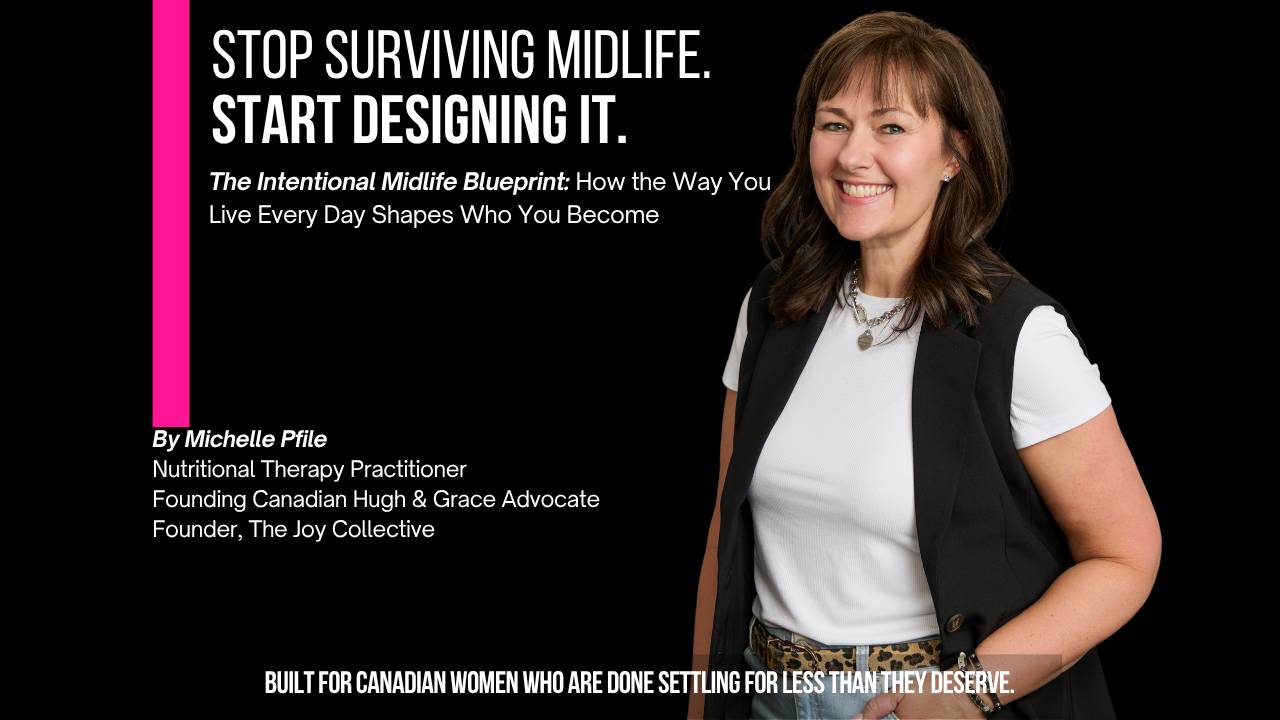
The Intentional Midlife Blueprint is my free guide for Canadian women who want to understand their hormones, reduce their toxic load, and age with intention.
Inside you'll find the full Glow Plate framework, the 6 pillars of intentional midlife health, what's accelerating your aging right now and exactly how to slow it down, and your daily longevity checklist for morning, afternoon and evening.
It's completely free and it's built for the Canadian woman who is done settling for less than she deserves.
YES — GRAB THE FREE BLUEPRINT
You were never broken. You just didn't have the full picture. Until now.
Michelle xx
Curious About My Daily Wellness Routine?
As a Nutritional Therapy Practitioner and a woman navigating midlife myself, I'm often asked what products I personally use and recommend most often.
I've put them all together in one place.
Nutritional Therapy Practitioner Founding Canadian Hugh & Grace Advocate Founder, The Joy Collective